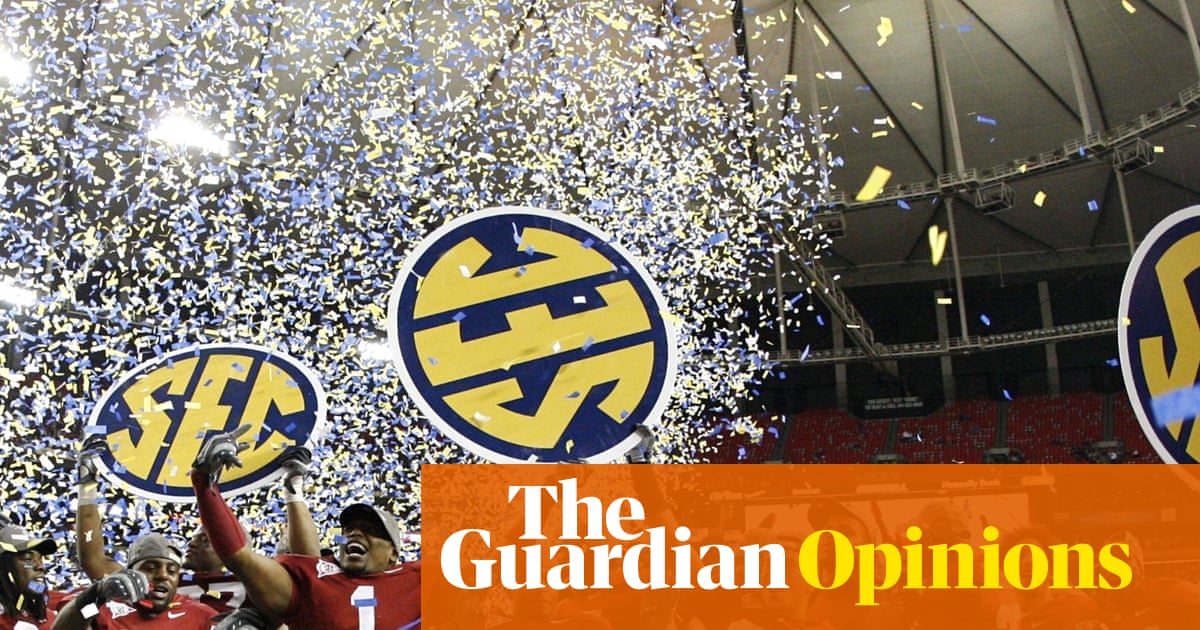
This week, the National Association for the Advancement of Colored People (NAACP) turned to sports to join part of its dissent, calling for Black athletes to boycott public universities in the Southeastern Conference (SEC), arguably the most powerful football conference in the country and certainly its greatest incubator of Black athletic talent. The NAACP is responding to a political attack with a social and economic one, for no institution is as culturally relevant in the south as college football, and few economic engines gain as much public attention as sports.
The NAACP is betting that Black Americans will recognize, finally, the urgency of the moment, that the parents of these gifted, valuable youths will join the fight, put two and two together and realize their power. Black people represent 14% of the population, but they are certainly more than 14% of American culture, and the Black athlete is the most successful, most influential and most visible Black employee this country has ever produced. A sustained, coordinated movement of Black athletes against hostile states would have a profound effect on football fields and basketball courts – as well as politics.
The sports industry, if it recognizes a potential threat at all, is betting on apathy and nihilism, that no one can be bothered to engage in anything but themselves. They want the Black players to believe they are powerless when they are anything but, to think they are separate from the ground battle taking place in their communities.
Black athletes have been here before. In 2015, a University of Missouri campus protest brought down the school’s president and system chancellor when the Black football players threatened to boycott games unless student demands were met. In the 1960s, the exodus of Black high school talent from the south forced southern universities to integrate. Americans have comforts and luxuries, big televisions and cars – but history has proved that boycotts work.
The Black collegiate football or basketball player has more power today than ever. Athletes can now be compensated with name, image, and likeness (NIL) deals. The freedom of the transfer portal means they can change schools without having to sit out a year.
A boycott of the SEC, which includes Florida (whose governor, Ron DeSantis, has led the charge in banning books by Black authors), Louisiana (where the supreme court case that cleaved the Voting Rights Act originated), South Carolina, Alabama and Tennessee (which are all in the process of massive disenfranchisement of Black voters through redistricting), and Texas would have an immediate impact. The NFL, whose player workforce is roughly 70% Black, recently awarded Tennessee the 2030 Super Bowl.
As they did in the 1960s, Black players could flex their political muscle by making themselves available to northern, midwestern and west coast powerhouses. NIL money combined with a political conscience and strategy represents a powerful response. The SEC is the NAACP’s target, but the Atlantic Coast Conference (ACC) also has schools in Florida, Virginia, North Carolina and South Carolina.
We are in a pivotal moment. The Trump presidency receives the focus – on brand for an America that has mastered centering on one culprit while leaving the broader disreputable culture intact – but the country’s institutions have exposed their own by their compliance, their own racism. Sports carries sociopolitical weight only through the quest for equality – racial, economic, gender. The triumphs of Jackie Robinson, Bill Russell and Billie Jean King made sports more than just bread and circuses. The Black political voice in sports is an essential element of understanding the games, and the people who play them, and the country we inhabit.
But over the last half-decade, sports media has willingly eliminated that voice, which is to say it has willingly abnegated its journalistic responsibility, which is to say it is culpable. Muting the athletes by reducing them into neutered laborers who entertain the often predominantly white season-ticket buying and broadcasting engines that fuel the sport is collaboration. While Trump is called a racist, that title applies to many an editor who has decided to stifle the Black voice because the country has gotten over the very public murder of George Floyd, a charge especially true in a sports business where the workforce is nearly three-quarters Black.
Sports media – responding both to white audiences who want their entertainment uncomplicated and their own biases to ignore the Black perspective – has engaged in a simplistic but effective con. There are plenty of Black faces on sports television, – addressing the empty catch-all of “representation”, but what exactly is being represented? What is left: Black ex-players replacing Black journalists, yelling at each other on TV without depth, reportage, without coverage of a major national story – its silence a collaboration. ESPN responded to the NAACP boycott with a wire story on its website. In less than a day, the story had all but disappeared. The words “athlete activism” feel as outdated as “groovy”.
It is in the interest of rights holders to convince Black athletes that their only value is to play and be grateful, to reinforce the dead-or-in-jail-if-not-for-sports narratives that guarantee their silence. The NAACP is asking the players – and their parents – to be interested in more than the bouncing ball.
The NAACP action is a reminder that Black athletes have power – if they choose to use it. They are, like it or not, inextricably linked to the future of Black America because of the economic profits they generate in areas friendly and hostile, and the cultural cachet they hold. As an economic bloc, they can shift the fortunes of the institutions they inhabit. If one thing can be certain, it is that there is plenty of money for sports in America. If Alabama or LSU can pay a wide receiver, so can Oregon. Or USC. Or Michigan.
After a decade of activity in the 2010s, athletes have been largely silent politically since the Floyd protests in 2020. They did not mobilize after January 6, even though the insurrection of the most symbolically important legislative building in the world was populated by the same political base that told the players their anthem protest was disrespectful. The players went back to playing, but the anti-Blackness only intensified. The players nevertheless remain part of a Black athletic heritage – and a civil rights heritage as Black people – that literally laid down its life for the comforts that are now being erased, and a new generation is being asked to pay their share. Why should they? Why do they owe? Because they have received.
-
Howard Bryant is the author of 11 books, including The Heritage: Black Athletes, A Divided America, and the Politics of Patriotism and Kings and Pawns: Jackie Robinson and Paul Robeson in America.